
Read: Cement Industry From Start to Future
A History of Building Materials: Cement and the Cement Industry
This document provides a concise overview of the history of building materials, with a specific focus on cement and the evolution of the cement industry. It traces the use of binding agents from ancient times through the development of modern Portland cement and the subsequent growth of the global cement industry.
Early Building Materials
Humans have been constructing shelters and structures for millennia, utilizing readily available materials. Early building materials were primarily natural and minimally processed, including:
-
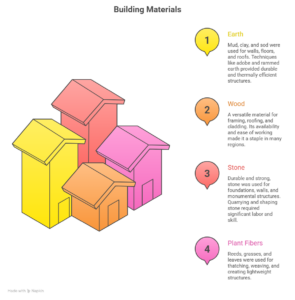
Earth: Mud, clay, and sod were used for walls, floors, and roofs. Techniques like adobe (sun-dried mud bricks) and rammed earth provided durable and thermally efficient structures.
-
Wood: A versatile material for framing, roofing, and cladding. Its availability and ease of working made it a staple in many regions.
-
Stone: Durable and strong, stone was used for foundations, walls, and monumental structures. Quarrying and shaping stone required significant labor and skill.
-
Plant Fibers: Reeds, grasses, and leaves were used for thatching, weaving, and creating lightweight structures.

These materials were often combined with binders to create more durable and stable structures.
The Dawn of Binding Agents
The need to bind together stones, bricks, and other building elements led to the development of early binding agents. These materials, precursors to modern cement, played a crucial role in the construction of enduring structures.
-
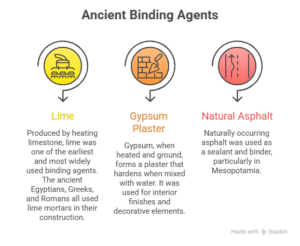
Lime: Produced by heating limestone, lime was one of the earliest and most widely used binding agents. The ancient Egyptians, Greeks, and Romans all used lime mortars in their construction.
-
Gypsum Plaster: Gypsum, when heated and ground, forms a plaster that hardens when mixed with water. It was used for interior finishes and decorative elements.
-
Natural Asphalt: Naturally occurring asphalt was used as a sealant and binder, particularly in Mesopotamia.

Roman Concrete: A Revolutionary Advance
The Romans made a significant advancement in binding technology with the development of Roman concrete (opus caementicium). This material, which used a combination of lime, volcanic ash (pozzolana), and aggregate, possessed exceptional strength and durability.
-
Pozzolanic Reaction: The key to Roman concrete’s strength was the pozzolanic reaction, in which volcanic ash reacted with lime in the presence of water to form a strong, cementitious compound.
-
Enduring Structures: Roman concrete allowed for the construction of massive and enduring structures like the Pantheon, aqueducts, and roads, many of which still stand today.
The Middle Ages and the Renaissance
Following the decline of the Roman Empire, the use of Roman concrete declined, but lime mortars continued to be used in construction. During the Middle Ages and the Renaissance, builders rediscovered and refined techniques for producing high-quality lime mortars.
-
Hydraulic Lime: The discovery of hydraulic lime, which could set underwater, was a significant advancement. This type of lime contained impurities that allowed it to react with water and harden even in the absence of air.
-
Brick Construction: Brick became increasingly popular as a building material, and lime mortars were essential for bonding bricks together.
The Development of Portland Cement
The modern cement industry began with the development of Portland cement in the 19th century.
-
Joseph Aspdin (1824): Joseph Aspdin, a British bricklayer, patented “Portland cement,” named for its resemblance to Portland stone, a popular building stone in England. Aspdin’s cement was produced by burning a mixture of limestone and clay.
-
Improved Manufacturing Processes: Subsequent inventors and engineers improved the manufacturing process, leading to a more consistent and higher-quality product. Isaac Charles Johnson is credited with achieving a clinkering process, a high-temperature burning that significantly improved the cement’s strength and durability.
The Rise of the Cement Industry
The invention of Portland cement revolutionized construction, enabling the creation of stronger, more durable, and more versatile structures. The cement industry grew rapidly in the late 19th and early 20th centuries.
-
Industrial Revolution: The Industrial Revolution fueled the demand for cement, as it was used in the construction of factories, bridges, and other infrastructure projects.
-
Global Expansion: Cement production spread rapidly around the world, with factories being established in Europe, North America, and Asia.
-
Technological Advancements: Continuous improvements in manufacturing technology, including rotary kilns and improved grinding techniques, increased production efficiency and reduced costs.
20th and 21st Century Developments
The 20th and 21st centuries have seen further advancements in cement technology and the growth of the global cement industry.
-
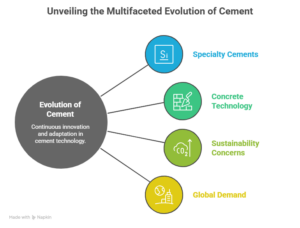
Specialty Cements: The development of specialty cements, such as high-alumina cement and sulfate-resistant cement, expanded the range of applications for cement.
-
Concrete Technology: Advances in concrete technology, including the use of admixtures and improved mix designs, have enhanced the performance and durability of concrete structures.
-
Sustainability Concerns: The cement industry faces increasing pressure to reduce its environmental impact, particularly its carbon footprint. Efforts are underway to develop more sustainable cement production processes and alternative cementitious materials.
-
Global Demand: Cement demand continues to grow, particularly in developing countries, driven by urbanization and infrastructure development.
The Future of Cement
The future of the cement industry will likely be shaped by the need for greater sustainability and the development of innovative materials.
-
Alternative Cementitious Materials: Research is focused on developing alternative cementitious materials, such as geopolymers and alkali-activated materials, which have lower carbon footprints than Portland cement.
-
Carbon Capture and Storage: Technologies for capturing and storing carbon dioxide emissions from cement plants are being explored as a way to reduce the industry’s environmental impact.
-
Circular E
-
conomy: Efforts are being made to promote a circular economy in the cement industry, by using recycled materials and reducing waste.

In conclusion, the history of building materials, particularly cement, is a story of continuous innovation and adaptation. From the earliest use of mud and lime to the development of modern Portland cement and beyond, humans have constantly sought to improve the materials and techniques used to construct the built environment. The future of the cement industry will depend on its ability to address sustainability challenges and develop innovative solutions to meet the growing demand for durable and resilient infrastructure.